Thursday, December 12, 2013
Goodman Brown: The man who saw true evil
After reading Hawthorne's Young Goodman Brown, I was confused as to what the author was trying to convey, and decided to look closer at the major events. Like many of the other literary works that center around the puritan way of life, religious piety plays into the story in some way. In this case, due to puritan life being about being pure Christians, Goodman Brown was just trying to follow what he had been taught all along. In the end he stayed the way he was at the beginning, but saw evil in everyone else because of their actions. There is a lesson to be learned from this story, as it reveals what most fail to see about themselves. Sometimes we instill an idea in someone and tell them to adhere to it for fear of punishment, failure, or loss. However, we fail to follow what we teach others to do or not to do at times, which raises a question. How can one warn another against something, while engaging in the very behavior, or action, he or she warned against? From the puritan view of it, Goodman Brown was most likely fearful and sad because he saw the truth. No one is perfect and there is evil in us all, along with good. The moral of the story, from my stand point, is that there is no such thing as perfect and that everyone is capable of good and evil.

Wednesday, December 11, 2013
What's behind the black Veil?
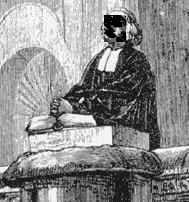
I recently reread Hawthorne's The Minister's Black veil after I began thinking about the veil covering the minister's face. The one thing I found more chilling than the story itself was how this poor soul subjected himself to a life of solitude and sadness. I began to wonder why someone who is surrounded by such happiness can throw it all away and withdraw into such darkness. Looking deeper into it, I discovered that the black veil was a representation of self punishment for sin. Being that this story was set in a puritan villiage in New England, I found myself asking why such practices were in place and what such actions said about the puritan society.
1) The puritans were firm believers in living godly lives, yet they dished out punishments at times which were far more evil than the sins themselves.
2) Many of said punishments were more psychological in nature than physical.
It is said that the minister wore his veil out of penance for his own sin of pride. Yet how could a man of God not realize that he could simply ask to be forgiven by way of prayer or confession? While his reason for wearing the veil is never disclosed, something far more disturbing is presented in its place. Some people, regardless of how happy they are, can fall into despair and never return.
1) The puritans were firm believers in living godly lives, yet they dished out punishments at times which were far more evil than the sins themselves.
2) Many of said punishments were more psychological in nature than physical.
It is said that the minister wore his veil out of penance for his own sin of pride. Yet how could a man of God not realize that he could simply ask to be forgiven by way of prayer or confession? While his reason for wearing the veil is never disclosed, something far more disturbing is presented in its place. Some people, regardless of how happy they are, can fall into despair and never return.
Sunday, December 8, 2013
A scarlet Letter on humanity

Of the many literary works I read over the semester, none stood out to me more than The Scarlet letter. Hester Prynne started out wearing it as a form of punishment, then grew to see it as a badge of honor in the end. But what of the puritan society that bestowed this mark upon her? Though they stressed religious piety and complete devotion to a sinless life, they bore their own scarlet letter by way of the Salem witch trials. Thus, it could be said that America itself is like Hester prynne ,in the sense that the killing of innocents as witches branded the very image of puritan society and early American history with a red letter A of sorts. However, just as it did in Hawthorne's story, what the A stands for has changed over time. At first, It could have stood for "Afraid", largely because of the fear of the unknown that fueled such tragic events. In the years following that era, it may have come to stand for " appauling", due to the nature of what took place.Today, this figurative letter our history bears has come to stand for " Acceptance" because we have learned from such mistakes. Over all, I believe that The Scarlet Letter and literary works like it are actually about the marks of shame we bear on ourselves in how we live among each other.
Friday, October 18, 2013
what does " The Telltale heart"say about the heart of humanity?
In my further readings of Poe's classic chilling tales, I came across The Telltale Heart. I hadn't read it all the way through, until now, and was very disturbed by the events of the story. After I finished reading, I was left with a question. What would drive someone to kill another person, simply because of a disturbing bodily feature? My curiosity prompted me to do some digging, which lead me to a very startling fact. This story was about the dark side of humanity, or rather the shadowy region of our being that we suppress for fear of consequences . With this in mind this story poses a few very important questions.
1. Is it possible that the things which disturb us in others are reflections of our own darkness? The man in the story was terrified by the old man's eye, which drove him to commit the violent act of murder. If the eyes are the window to the soul, could it be that he saw something in that eye that exposed a dark secret in his own soul?
2. Could such a story be an early exploration of criminal psychology? We have the crime, we have the guilty party, and we have the victim. What we don't have in the story is a true motive, only hints at what it could be. The killer acted out of his fear of the old man's eye, though nothing is said that would explain his actions. The events and outcome of the story itself suggest that the killer was disturbed by something. Thusly, there would be a need to explore that fact further.
Over all, It was a chilling, yet very entertaining story that gave a look at the darkness in all of us. I feel that without this story, the way we investigate certain crimes would be very different today.
1. Is it possible that the things which disturb us in others are reflections of our own darkness? The man in the story was terrified by the old man's eye, which drove him to commit the violent act of murder. If the eyes are the window to the soul, could it be that he saw something in that eye that exposed a dark secret in his own soul?
2. Could such a story be an early exploration of criminal psychology? We have the crime, we have the guilty party, and we have the victim. What we don't have in the story is a true motive, only hints at what it could be. The killer acted out of his fear of the old man's eye, though nothing is said that would explain his actions. The events and outcome of the story itself suggest that the killer was disturbed by something. Thusly, there would be a need to explore that fact further.
Over all, It was a chilling, yet very entertaining story that gave a look at the darkness in all of us. I feel that without this story, the way we investigate certain crimes would be very different today.
Tuesday, October 8, 2013
Poe's darkness points to history and so much more
It's interesting to look at what real life things are pointed out in literature. I never realized it, until recently, that Edgar Allan Poe was referring to the black plague when he wrote Masque of The red death. Though he doesn't really say outright where the events are taking place, the location of the masquerade gives the impression that the story takes place somewhere in Europe. As I thought on this for a while, I began reading up on the European Black plague of 1347 and saw the correlation right off. Though I had discovered this striking similarity, I began to wonder what Poe was really pointing out in this story. From what I've discovered, he was pointing out several things about who we are and who become in times of great fear.
Firstly, Poe was pointing out the fact that people hide behind wealth and power, thinking they are safe from death. The story is centered around a prince, who fancies himself fearless in the midst of such vast death. The reality is that death doesn't discriminate. Rich, poor, or in between, no one is exempt.
Secondly, he was pointing out that fear for one's own safety can lead him or her to forsake others in times of danger. The prince Prospero gathered his fellow noble men and women to join him in a safe location, far away from the commoners who relied on them for answers. In the end, death took them as it had taken the common people. It had no concerns in regards to wealth or royalty, nor did It give warning of its arrival.
In a way, it could be said that Masque of The Red Death Set the bar for what we know as the modern day zombie plague genre. Just as Poe's characters displayed their willingness to leave those without wealth or power to die, those in most of the literature and movies of that Genre seem to have the same kind of people displaying the same behavior. Over all, I was intrigued by the fictional and non fictional similarities.
Firstly, Poe was pointing out the fact that people hide behind wealth and power, thinking they are safe from death. The story is centered around a prince, who fancies himself fearless in the midst of such vast death. The reality is that death doesn't discriminate. Rich, poor, or in between, no one is exempt.
Secondly, he was pointing out that fear for one's own safety can lead him or her to forsake others in times of danger. The prince Prospero gathered his fellow noble men and women to join him in a safe location, far away from the commoners who relied on them for answers. In the end, death took them as it had taken the common people. It had no concerns in regards to wealth or royalty, nor did It give warning of its arrival.
In a way, it could be said that Masque of The Red Death Set the bar for what we know as the modern day zombie plague genre. Just as Poe's characters displayed their willingness to leave those without wealth or power to die, those in most of the literature and movies of that Genre seem to have the same kind of people displaying the same behavior. Over all, I was intrigued by the fictional and non fictional similarities.
Saturday, October 5, 2013
Black cats
I've never quite understood why the main character in Poe's The Black Cat expressed such cruelty toward the cat he so cherished. Perhaps this story is symbolic of our destructive nature toward what we love the most. This, of all his writings, has brought me to look reevaluate my own understanding of how affection, especially that expressed by a cherished pet, can bring a person back from the brink of insanity.


The raven in us all

Just the other day, I was reading Edgar Alan Poe's The Raven. I've read this story many times in the past and have come to accept it as a favorite, largely because the raven isn't just a bird. look hard enough and you'll see that it is an animal representation of the unknown, which we as human fear the most.Being that the story itself deals with the loss of a loved on and the aftermath of such a tragedy, It's easy to see that Poe, in mid lament, come face to face with cold uncertainty. I believe that the raven wasn't really an actual bird, but his inner fears running free to torment him.
This notion brought into question how other animals in literature have pointed out parts of our own human nature.I was surprised to find that countless representations of human nature through the characterization of animals has been a part of literature for centuries. The foxes, lions, wolves and other animals of Greek fables give us the best proof of this. In one instance, mice outwitted a cat by tying a bell around a cat's neck as a warning of impending danger. Just as the raven represented Poe's fear of the unknown, the mice are a representation of our own combativeness in the event of a threat.
Having seen this in The raven and other literary favorites of mine, I started to wonder, after realizing this truth, why animals were used to point out these parts of us, rather than just identifying them outright. I've concluded three reasons for this.
1) Animals are used to represent human nature because they can be put in a position in which they must act as we would to come to a resolution or agreement. We pay more attention to this because it's presented to us from an outside point of view, as if we're looking in on ourselves in action.
2) Using animals to express human nature helps to convey the feelings of the characters, thereby adding emotion to the story and keeping the reader interested.
3) Such a method allows the reader to better connect with the characters, by relating the emotions those characters express to their own.
Poe's story, in my opinion, was a groundbreaking literary masterpiece, not only because of its use of such emotion, but because it says so much about who we really are inside.
Subscribe to:
Comments (Atom)